Just Fashion Part II: 'Industry 4.0' in the Fashion Value Chain: Revolution or Farce?
In the following series of longreads, PhD researcher Tessa Boumans explains the relationship between fashion, technology, and a just future. These longreads serve as an introduction to her book 'Just Fashion', which will be published later this year.
In Part I of this series, I explored the history of technology and clothing. I discussed how the third industrial revolution, the ‘digital revolution’, relates to what we now call the 'fourth industrial revolution': an era of supposedly 'more advanced' technology, with AI, Big Data, machine learning, IoT, and Blockchain as its most familiar faces. In this article, we zoom in on exactly those technologies. How are they being used in the fashion industry? Are they really as groundbreaking as tech companies and fashion brands would have us believe? And what is their social and economic impact?
Why it matters how we talk about technology
Technology is never neutral. Who develops a technology, for what purpose, and for whom; it makes an enormous difference. If pure efficiency or quality always won out, we would have ditched the QWERTY keyboard long ago. The question we should ask about every technological development is therefore: who actually benefits?
That technology is not neutral is something critics have known for decades. The debates that follow from this are more urgent than ever. Who owns and controls data, and who doesn't? To what extent do technologies enable surveillance of citizens, consumers, and workers? How does the dominance of tech giants contribute to unfair monopolies? And how do differences in access to technology create greater inequality? All of these questions are not only relevant to Silicon Valley, they cut straight to the heart of the fashion industry too. And we don’t talk about that enough.
###Which technologies are we talking about? It is impossible to cover all relevant technologies exhaustively. Nevertheless, there are a number of categories that keep coming up and are most worth examining critically: robotics, the Internet of Things (IoT), Blockchain, radio-frequency identification (RFID), machine learning (ML), augmented and virtual reality (AVR), 3D software, Big Data, and artificial intelligence (AI).
Although I discuss these technologies separately, they are far from independent of one another. They overlap, reinforce, and influence each other constantly. Keep that in mind as we explore them one by one.
1. Industrial robotics and automation
Talk to people about technology in industry, and the conversation almost immediately turns to robots and automation. Not unreasonably, and as such we may as well start there.
The clothing industry has a reputation for being difficult to automate. That is a remarkable reputation for a sector that, as we saw in Part I, has been so closely intertwined with technological progress throughout the centuries. Yet there is a kernel of truth in it. Automation seems to have been running up against an invisible ceiling for a long time. The electric sewing machine keeps getting more sophisticated, but there will always be a human needed to operate it. The reason lies in the fundamental nature of clothing itself: fabric is flexible and fluid, something that many rigid machines simply cannot handle. On top of that, while other industries can standardise components, clothing rarely allows for this. Styles change at breakneck speed, sizes vary endlessly. A sewing machine capable of keeping up must therefore be doubly flexible.
A fine challenge for the tech world, you might think: how do you build a machine that can produce clothing at scale with minimal human involvement? A number of startups are trying. Softwear Automation (US), Silana (Austria), Sewbo (US), and Mtsuya R&D (Japan) have developed machines capable of sewing standard T-shirts, hoodies, or jeans. But a genuine breakthrough, one that delivers on what the Industry 4.0 revolution promises, has yet to arrive.
What does stand out is the language used by companies promoting automation. They are fond of pointing to the abuses in the supply chain: the exploitation of workers, the poor working conditions. Automation as liberation, so the message goes. But that story deserves a more critical reading. In the most obvious scenario, these workers (predominantly women) are simply replaced by machines and lose their income. The reasoning of the tech companies turns things on their head: as if women working in the clothing industry are stuck in bad jobs they need to be freed from, rather than people who simply deserve to be paid decently. If their robots ever become widely deployed, it is primarily the tech companies themselves and the fashion brands that stand to profit handsomely. Whether there are any plans to provide social security for the workers who lose their jobs? Asking the question is answering it.
For now, however, it is mostly noise and little action. Not a single startup has yet managed to automate clothing production on a truly large scale.
What is realistic is the threat of automation - and that threat works even without a single robot picking up a needle. As long as wages are low enough, investing in expensive technology simply does not make financial sense. Garment workers are therefore not so much competing with machines themselves, but with the idea of them: with the marketing narratives sold at trade fairs, to governments, and online by smooth-talking salespeople with polished presentations. The machine as a pressure tool, without ever actually being switched on.
2. 3D design software and virtual fitting rooms
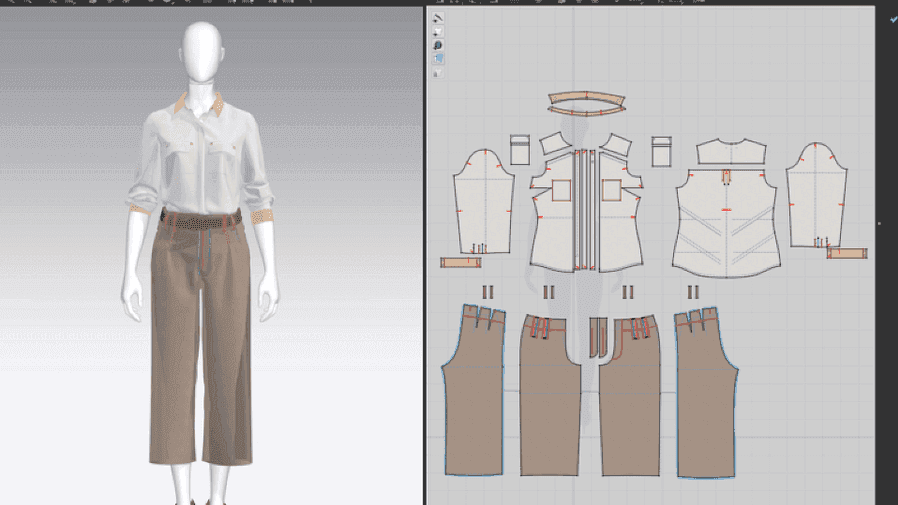
Computer aided design (CAD) has long since ceased to be a novelty in the fashion industry. Since the digital revolution, these systems have become standard practice, and thanks to generative AI and machine learning, they have been further refined in recent years. But here too: the evidence that human designers are being pushed out by these tools is currently lacking. Quite the opposite, in fact. According to willrobotstakemyjob.com, designers have only a 27% chance of being automated, which is relatively low, especially compared to models, who face a 69% chance and are far more vulnerable to digitalisation. Increasingly, we see fashion brands using AI models to replace human ones.
At the same time, 3D software is moving ever more from the background to the foreground. Think of apps that allow consumers to digitally 'try on' clothing before making a purchase. On the surface, it seems rather fun; shopping without a fitting room. But the system behind it deserves a more critical look.
Because what is actually the goal of these tools? Simple: design faster, and get people to buy more. The developers of this technology like to dress that up in green packaging. More efficient design means fewer physical samples, so the story goes, and if consumers can try things on virtually, they will buy better-fitting clothes, return less, and 'maybe even buy less'. But there is no evidence whatsoever for any of these claims. History points in precisely the opposite direction: every innovation that made production or consumption easier led not to less, but to more. More production, more purchases, more impact on the climate. There is no reason to assume it will be any different this time.
And then there is something that tech companies are conspicuously reluctant to mention: the digital world is not nearly as immaterial as it appears. That 'cloud' has a physical foundation: data centres, servers, kilometres of electricity cables. AI consumed more water last year than the entire country of Denmark, and emitted more CO₂ than the entire city of New York. In Amsterdam, a Microsoft data centre is soon to be built that will consume more electricity than the entire city of Haarlem. When developers of 3D software talk about how good their technology is for the environment, you will never hear them mention any of this.
3. The Internet of Things (IoT)
IoT stands for the Internet of Things. In short, it is the network of physical devices that collect and exchange data via the internet and automatically respond to it. You know the kind of thing: the Google Home device in the living room that controls the heating, Alexa that answers your questions (and listens rather carefully herself), the Ring doorbell that checks whether parcels have been delivered (and whether the neighbours are home), and the smart lights you control with your phone.
What does that have to do with clothing? More than you might think.
Although the clothing industry manages to produce billions of garments every year, it does not consider itself an efficient industry by any means. The supply chain is riddled with unexpected disruptions: quality controls that flag errors late in the process, samples that fail approval and have to be remade, orders delayed by miscommunication between manufacturers and brands, or raw materials that arrive too late. All of these disruptions cost money, and fashion brands want to prevent them as much as possible.
That is where IoT applications come in. With smart sensors and connected devices, brands can track in real time how quickly products are being made, where in the logistics chain a shipment is located, and where bottlenecks arise. Quality controls can also be carried out faster and more accurately with IoT technology. Always ask yourself: whose risks are actually being managed here?
But the proliferation of 'smart solutions' also creates a new problem: all these systems were not designed to communicate with one another. That explains the rise of so-called end-to-end providers, who attempt to connect all the separate links in the chain into one coherent system from start to finish.
Streamlining the supply chain is not in itself a bad goal. But the question is who ultimately gains control over it. The answer is unsurprising: not the workers or the vulnerable actors in the chain, but the parties that already had the most capital and the most power. Fashion brands and tech companies are thus tightening their grip on a chain they already dominated.
IoT also appears in the concept of the 'smart factory'. Smart factories run on technology and as few human hands as possible, and are seen in Western countries as the solution to bringing production back home. They may generate profit, but barely any jobs, as we already see, for example, at Amazon in the US. Although Amazon of course sells all kinds of products, it also qualifies as a fashion brand.
And to the extent that people still play a role on the shop floor, the question is whether these are dignified roles. Working at the pace of machines, in an environment full of cameras and sensors, places enormous pressure on workers. A factory that is truly smart takes into account what people need to work well and healthily, and develops technology together with those people rather than over their heads. In practice, we see very little of that.
4. RFID
RFID is essentially a classic Industry 3.0 technology, but it still deserves a place in this story. Not so much for its technological sophistication, but because in the Industry 4.0 era it is increasingly being swept up into a broader pattern: that of capital holders using technology to gain ever greater control over the supply chain.
But first: what is RFID? RFID stands for Radio Frequency Identification. At its core, it is a small chip with a unique code, linked to a specific product, component, or shipment. By scanning those tags at various points in the process, you can see at any moment where something is located — from raw material to shop floor.
So far, it all sounds fairly innocuous. Efficiency is always better, right? Why would you not want this? But behind that logistical innocence lies something worth pausing over. RFID is, like many technologies in this series, first and foremost an instrument of control — over products, yes, but also over the people who work with them.
There is a term for this: digital Taylorism. Where technology is deployed to closely monitor and direct the tasks, performance, and productivity of workers, making work increasingly fragmented and less autonomous. The chip on the garment records not only where the product is, but also implicitly how quickly someone is working, where delays arise, and who is responsible for them. The efficiency gains are real — but the question is how far those gains are distributed across the chain.
The promise of RFID, transparency, traceability, control, sounds appealing on paper, including for consumers who want to know where their clothing comes from. But it is important to stay sharp about who that transparency actually serves. In practice, the information generated by RFID systems flows primarily upward in the chain: to brands, buyers, and tech companies. Not to the worker who sewed the garment, not to the consumer who buys it. The data becomes the property of the parties who own and fund the infrastructure, and they use it primarily to cut costs and tighten control over processes. Transparency as a selling point, control as reality. As long as the architecture of these systems is determined by capital rather than by the interests of workers or consumers, RFID does not change the power relations in the chain — it reinforces them.
5. Blockchain
You have probably heard of blockchain (that vague system that spawned bitcoin), but the chances are you have never stopped to consider its role in the clothing industry. That is understandable — it is also a peculiar combination. In my view, a forced one.
As I said in Part I: you do not need to understand exactly how a technology works in order to think critically about it. That is doubly true for blockchain. All you need to know is this: blockchain is a way of recording data in a shared digital ledger that cannot be altered by any single party, and that is verifiable by everyone.
Why would the clothing industry find that useful? Some logistics experts point to the transparency it offers: various actors in the chain enter data, and no one can secretly change it afterwards. That resonates in an industry rife with mutual distrust. Can you trust your supplier's supplier? Is the middleman fiddling with the data? But there is an immediate problem: blockchain only prevents data from being altered after it has been entered. At the moment of entry, manipulation is still entirely possible. The system is only as trustworthy as the people feeding it — and that is precisely the problem it is supposed to solve.
More interesting, and more telling, is the embrace of blockchain by luxury fashion brands. They hope to use it to create digital passports for their products, as a weapon in the fight against counterfeiting. Not without reason: many products from expensive brands are nowadays made in the same factories as fast fashion, and the quality of 'superfakes' has become so high that they are barely distinguishable from originals. Blockchain is meant to redraw the line between real and fake.
But many questions arise here. People who buy a counterfeit bag do so either deliberately or because they did not bother to check whether it was genuine. In the first case, a digital passport has no effect whatsoever. In the second, the question is whether those same people will suddenly go to the trouble of doing their digital homework. The problem that blockchain is supposed to solve looks more like a marketing story than a genuine technological challenge.
And then there is something that is completely absent from this narrative: the people who depend on the counterfeit industry for their income. The making and selling of fake products takes place largely in the informal economy, which provides work for around 2 billion people worldwide. Sixty percent of the global workforce works in the informal sector. These are the people being targeted by the war on counterfeiting — not the owners of luxury fashion houses, many of whom count among the wealthiest people on earth.
Obviously, I fully support the idea that people deserve more dignified work than a life of uncertainty and illegality. But blockchain is not the path to get there. It is more of a textbook example of how easy it is to overlook the broader consequences of technology, and of how readily the wealthiest players in the industry package their own interests as a solution to a larger problem. You can read more about how luxury brands are lobbying for blockchain in this SFM article. There are undoubtedly more effective ways for these brands to help move the clothing industry toward a more just future — which we will explore further in Parts III and IV of this series. Blockchain is not one of them.
6. Big Data
Big fashion cannot exist without Big Data. Big Data refers to enormous, complex datasets that are analysed using advanced software to uncover patterns and insights,** and it has become the backbone of the modern fashion industry**. Where companies in the Industry 3.0 era still worked with manageable, structured datasets for internal efficiency, Industry 4.0 goes considerably further: real-time data streams from IoT sensors, social media, e-commerce platforms, and global supply chains are continuously analysed to predict trends, personalise consumer experiences, and optimise production processes. These analyses are then used to steer the market in line with the interests of those who have access to the data.
The major players are already doing this at scale. Zara adjusts its collections daily based on sales data from physical stores. Nike, H&M, Uniqlo, and Amazon use data for everything from inventory management to personalised recommendations. Shein built its entire business model on algorithms that pick up microtrends in real time and translate them into new products. For smaller brands, the barrier remains high, though affordable cloud solutions are making it increasingly accessible.
But here is where the problems begin. Because data is power; and that power is far from equally distributed.
American professor Shoshana Zuboff described in her book Surveillance Capitalism how large tech companies collect personal data, often without explicit consent, to predict and shape human behaviour for commercial gain. That logic applies in full to the fashion industry. The microtrends that follow one another in rapid succession are not a spontaneous social phenomenon. They are actively driven by algorithms and the relentless profit logic of brands. When a brand claims it is simply following consumer demand, that is, in the age of surveillance capitalism, straightforwardly misleading. They are shaping that demand.
Then there is the privacy question. The oft-heard argument: "if you have nothing to hide, you have nothing to fear", deserves a response. Privacy is not about secrecy: it is about control over your own information. The right to decide who has access to your data and how it is used is a fundamental right, not a privilege reserved for people with something to hide.
This power imbalance also affects workers further down the chain. Algorithms measure factory efficiency, predict delays, and push for faster turnaround times. Performance data is used to cut costs, leading to heavier workloads, longer hours, and lower wages. Workers, especially in countries with weak labour protections, have virtually no say in these decisions. For smaller factories, it is even harder: those who cannot meet the data-driven demands of large brands lose orders to bigger competitors. The result is a race to the bottom, in which costs are cut at the expense of people and sustainability. We are moving ever closer to an oligopoly of large fashion conglomerates.
Big Data has undeniable advantages, particularly when it is produced, analysed, and deployed democratically. But as long as access to it remains so unequally distributed, it primarily reinforces the existing inequalities in the industry, rather than dismantling them.
7. Artificial Intelligence and Machine Learning
And here we finally are: AI. No technology in recent years has been so hyped, so feared, and so shrouded in mystique as artificial intelligence. But what is it actually, and what is it doing in the fashion industry?
One important thing to note: AI in the fashion industry is not new. During the Industry 3.0 era, task-specific and predictive AI was already widely used for pattern design, supply chain management, and quality control. What distinguishes the Industry 4.0 era is not the invention of AI, but the scale, the accessibility, and the extent to which different AI systems have become intertwined with one another. While the visibility of AI has exploded in recent years, the technology itself has been quietly humming beneath the surface of the fashion industry for much longer.
That brings us back to a point I made at the start of this article: technologies rarely stand on their own, and more often they are woven into a web of overlapping functions. AI is no exception; it runs through all the technologies I have already discussed and plays an increasingly significant role in areas including trend forecasting, design and product development, and retail and e-commerce.
Worth highlighting in this section is the promise of AI in recycling. Tech developers like to claim that their AI solutions are making the industry greener. The reality is more nuanced. AI can play a meaningful role in textile recycling: computer vision and machine learning can sort fabrics more accurately than humans, something companies like Worn Again Technologies and Fibersort are already putting into practice.
But AI does not solve the root problem: overproduction. Recycling has itself become a business model that enables brands to justify overproduction under the banner of circularity. Moreover, automated sorting threatens the informal economies of the Global South. In countries like Ghana, Kenya, and India, millions of people depend on the trade in second-hand clothing for their livelihoods. AI-driven recycling risks stripping away that foundation and concentrating profits in the hands of tech companies and large fashion brands. While these recycling markets are in absolute need of change, this change should be led by the people that are dependent on these systems and participate in them daily, not by western actors who hold the power of AI.
AI permeates the entire fashion chain, from trend forecasting to recycling. It is not magic, and it is not the end of the world. But as long as the rules of the industry remain unchanged, AI will primarily deliver more of what we already have: faster production, more consumption, and a chain in which power concentrates in the hands of those who already dominated it.
Conclusion: technology as a mirror
And that, for now, appears to be the conclusion for most of the 'Industry 4.0' technologies we currently see emerging in the clothing industry. Although standing in front of the mirror is an essential part of our daily clothing routine, the fashion industry itself rarely seems to look into one.
The promise of Industry 4.0 is considerable: more efficient production, less waste, greater transparency, better working conditions. And yes, technology can play a positive role. AI can sort textiles more effectively for recycling. IoT can reduce waste in the supply chain. 3D software can cut the number of physical samples. The possibilities are real.
But anyone who looks critically at the technologies in this series will see the same pattern recurring. The companies developing and rolling out these tools are rarely the workers at the bottom of the chain, the small manufacturers, or the consumers trying to live more consciously. They are the parties that already had the most capital and the most power, and they are using technology primarily to consolidate that position: more control over the chain, more data on consumers, more pressure on factories to produce faster and cheaper.
Technology does not solve problems that are fundamentally political and economic in nature. As long as the rules of the industry remain unchanged — as long as speed matters more than fairness, and profit more than dignity — every new technology will adapt to those rules. Not as a disruptor, but as an accelerator of what was already there.
The question is therefore never just: what can this technology do? It is always: who does it work for, who pays the price, and who gets to decide? As long as we do not place those questions at the centre of the debate about the future of the fashion industry, technology will remain, above all, a compelling story, told by those who profit from it most.
---------------------------------------------------------------------------------------------------------------------------------------
🇳🇱 In de volgende reeks longreads legt PhD-onderzoeker Tessa Boumans de relatie uit tussen mode, technologie en een rechtvaardige toekomst. Deze longreads vormen een introductie op haar boek ‘Just Fashion’, die later dit jaar verschijnt.
In deel I van deze serie dook ik in de geschiedenis van technologie en kleding. Ik besprak hoe de derde industriële revolutie, ook wel: ‘de digitale revolutie’, zich verhoudt tot wat we inmiddels de 'vierde industriële revolutie' noemen: een tijdperk van zogenaamd 'geavanceerdere' technologie, met AI, Big Data, machine learning, IoT en Blockchain als bekende gezichten. In dit artikel zoomen we in op precies díe technologieën. Hoe worden ze ingezet in de mode-industrie? Zijn ze echt zo baanbrekend als techbedrijven en modemerken ons willen doen geloven? En wat is hun maatschappelijke en economische impact?
Waarom het er toe doet hoe we over technologie praten
Technologie is nooit neutraal. Wie een technologie ontwikkelt, met welk doel en voor wie: het maakt enorm veel uit. Als louter efficiëntie of kwaliteit de doorslag zou geven, zouden we bijvoorbeeld allang geen QWERTY-toetsenbord meer gebruiken. De vraag die we bij elke technologische ontwikkeling zouden moeten stellen, is dan ook: wie heeft hier eigenlijk baat bij?
Dat technologie niet neutraal is, weten critici al decennia. De debatten die daaruit voortkomen, zijn urgenter dan ooit. Wie bezit en controleert data en wie niet? In hoeverre maken technologieën surveillance van burgers, consumenten en werknemers mogelijk? Hoe draagt de dominantie van techgiganten bij aan oneerlijke monopolies? En hoe zorgen verschillen in toegang tot technologie voor grotere ongelijkheid? Al deze vragen zijn niet alleen relevant voor Silicon Valley, maar raken ook de kledingindustrie.
Over welke technologieen gaat het?
Het is onmogelijk om alle relevante technologieën uitputtend te behandelen. Toch zijn er een aantal categorieën die steeds terugkeren en het meest de moeite waard zijn om kritisch tegen het licht te houden: robotica, het Internet of Things (IoT), Blockchain, radio-frequency identification (RFID), machine learning (ML), augmented en virtual reality (AVR), 3D-software, Big Data en artificiële intelligentie (AI).
Hoewel ik deze technologieën afzonderlijk bespreek, zijn ze verre van onafhankelijk van elkaar. Ze overlappen, versterken en beïnvloeden elkaar voortdurend. Houd dat in gedachten terwijl we ze één voor één verkennen.
1. Industriele robotica en automatisering
Praat je met mensen over technologie in de industrie, dan gaat het bijna altijd direct over robots en automatisering. Niet onlogisch — en we kunnen net zo goed daar maar meteen mee beginnen.
De kledingindustrie heeft de reputatie moeilijk te automatiseren te zijn. Dat is een opmerkelijke reputatie voor een sector die, zoals we in deel I zagen, door de eeuwen heen juist zo nauw verweven is geraakt met technologische vooruitgang. Toch zit er een kern van waarheid in. Automatisering lijkt al lange tijd tegen een onzichtbaar plafond aan te lopen. De elektrische naaimachine wordt steeds geavanceerder, maar er blijft altijd een mens nodig om hem te bedienen. De reden daarvoor is de fundamentele eigenschap van kleding zelf: stof is beweeglijk en soepel, iets waar veel starre machines geen raad mee weten. Daar komt nog iets bij: waar andere industrieën onderdelen kunnen standaardiseren, is dat bij kleding nauwelijks mogelijk. Stijlen wisselen elkaar razendsnel af, maten variëren eindeloos. Een naaimachine die dit aankan, moet dus dubbel zo flexibel zijn.
Een mooie uitdaging voor de tech-wereld, zou je zeggen: hoe bouw je een machine die, met minimale menselijke tussenkomst, toch massaal kleding kan produceren? Er zijn de nodige startups die een poging wagen: Softwear Automation (VS), Silana (Oostenrijk), Sewbo (VS) en Mtsuya R&D (Japan) ontwikkelden machines die standaard T-shirts, hoodies of jeans kunnen naaien. Maar een echte doorbraak, eentje die waarmaakt wat de industrie 4.0-revolutie belooft, is er nog niet gekomen.
Wat wél opvalt, is het taalgebruik van de bedrijven die automatisering promoten. Ze grijpen graag terug naar de misstanden in de keten: de uitbuiting van arbeiders, de slechte werkomstandigheden. Automatisering als bevrijding, zo luidt de boodschap. Maar dat verhaal verdient wat kritischer gekeken te worden. In het meest voor de hand liggende scenario worden deze arbeiders, overwegend vrouwen, simpelweg vervangen door machines en verliezen ze hun inkomen. De redenering van de techbedrijven draait het eigenlijk om: alsof vrouwen die in de kledingindustrie werken vastzitten in slechte banen waarvan ze verlost moeten worden, in plaats van mensen die gewoon fatsoenlijk betaald zouden moeten worden. Als hun robots ooit breed ingezet worden, zijn het vooral de techbedrijven zelf en de kledingmerken die daar flink aan verdienen. Of er ook plannen zijn om de sociale zekerheid van ontslagen arbeiders op te vangen? De vraag stellen is hem beantwoorden.
Voorlopig is het echter vooral veel lawaai en weinig actie. Geen enkele startup is er tot nu toe in geslaagd om de productie van kleding echt op grote schaal te automatiseren.
Wat wél realistisch is, is de dreiging van automatisering. En die werkt ook zonder dat er ook maar één robot daadwerkelijk een naald oppakt. Zolang de lonen laag genoeg zijn, is de investering in dure technologie simpelweg niet rendabel. Kledingarbeiders concurreren daarmee niet zozeer met machines zelf, maar met het idee ervan: met de marketing verhalen die op beurzen, bij overheden en online worden verkocht door slimme verkopers met mooie presentaties. De machine als pressiemiddel, zonder ooit echt aan te worden gezet.
2. 3D-designsoftware en virtuele paskamers
'Computer aided design' (CAD) is allang geen noviteit meer in de mode-industrie. Sinds de digitale revolutie zijn deze systemen gemeengoed, en dankzij generatieve AI en machine learning zijn ze de afgelopen jaren verder verfijnd. Maar ook hier geldt: het bewijs dat menselijke ontwerpers door deze tools worden verdrongen, ontbreekt vooralsnog. Integendeel zelfs. Volgens willrobotstakemyjob.com hebben designers slechts 27% kans om geautomatiseerd te worden. Dat is relatief laag, zeker vergeleken met bijvoorbeeld stakeholders zoals modellen, die met 69% kans een stuk kwetsbaarder zijn voor digitalisering. We zien dan ook dat steeds meer modemerken AI modellen gebruiken om ‘menselijke’ modellen te vervangen.
Tegelijk beweegt 3D-software zich steeds vaker van de achtergrond naar de voorgrond. Denk aan apps waarmee consumenten kleding digitaal kunnen 'passen' voor ze tot aankoop overgaan. Op het eerste gezicht best vermakelijk, lekker shoppen zonder pashokje. Maar het systeem erachter verdient een kritischere blik.
Want wat is eigenlijk het doel van deze tools? Simpel: sneller ontwerpen, en mensen meer laten kopen. De makers van deze technologie verpakken dat graag in een groen jasje. Efficiënter ontwerpen betekent minder fysieke samples, zo luidt het verhaal, en als consumenten virtueel kunnen passen, kopen ze beter passende kleding en retourneren ze minder, ‘misschien kopen ze zelfs minder’. Maar voor al deze claims bestaat geen enkel bewijs. De geschiedenis leert juist het tegendeel: elke innovatie die productie of consumptie makkelijker maakte, leidde niet tot minder, maar tot méér. Meer productie, meer aankopen, meer impact op het klimaat. Er is geen enkele reden om aan te nemen dat het deze keer anders zal zijn.
En dan is er nog iets wat techbedrijven opvallend graag verzwijgen: de digitale wereld is helemaal niet zo immaterieel als ze lijkt. Die ‘cloud’ heeft een fysiek fundament: datacenters, servers, kilometers aan elektriciteitskabels. AI verbruikte vorig jaar meer water dan heel Denemarken, en stootte meer CO₂ uit dan de hele stad New York. In Amsterdam wordt binnenkort een datacenter van Microsoft gebouwd dat meer stroom zal verbruiken dan de hele stad Haarlem. Wanneer ontwikkelaars van 3D-software vertellen hoe goed hun technologie is voor het milieu, hoor je hen hier echter nooit over.
3. Het ‘Internet der dingen’ (IoT)
IoT staat voor "Internet of Things" — het internet der dingen. Kort gezegd is het het netwerk van fysieke apparaten die via internet gegevens verzamelen, uitwisselen en daar automatisch op reageren. Je kent het wel: dat Google Home-apparaatje in de woonkamer waarmee je de verwarming regelt, Alexa die je vragen beantwoordt (en ondertussen zelf ook goed luistert), de Ring-deurbel die spiekt of er pakketjes zijn bezorgd (en of je buren thuis zijn), en de slimme lampen die je met je telefoon bedient.
Wat heeft dat met kleding te maken? Meer dan je zou denken.
Hoewel de kledingindustrie er ieder jaar in slaagt miljarden kledingstukken te produceren, beschouwt ze zichzelf allerminst als een efficiënte industrie. De productieketen kent talloze onverwachte verstoringen: kwaliteitscontroles die fouten aan het licht brengen laat in het proces, samples die niet goedgekeurd worden en opnieuw gemaakt moeten worden, bestellingen die vertraging oplopen door miscommunicatie tussen fabrikanten en merken, of grondstoffen die te laat aankomen. Al die verstoringen kosten geld, en modemerken willen ze het liefst zo veel mogelijk voorkomen.
Daar komen IoT-toepassingen om de hoek kijken. Met slimme sensoren en verbonden apparaten kunnen merken in real time volgen hoe snel producten worden gemaakt, waar in de logistieke keten een zending zich bevindt, en waar knelpunten ontstaan. Ook kwaliteitscontroles kunnen sneller en nauwkeuriger worden uitgevoerd met behulp van IoT-technologie. Zo kunnen ‘risico’s’ worden ingeperkt. Vraag je dan altijd af: risico’s voor wie?
Maar de veelheid aan 'slimme oplossingen' creëert ook een nieuw probleem: al die systemen zijn niet ontworpen om met elkaar te communiceren. Dat verklaart de opkomst van zogenaamde end-to-end aanbieders, die proberen alle losse schakels van begin tot eind aan elkaar te knopen tot één samenhangend systeem.
Het stroomlijnen van de productieketen is op zichzelf geen slecht streven. Maar de vraag is wie daar uiteindelijk de controle over krijgt. Het antwoord is weinig verrassend: niet de arbeiders of de kwetsbare actoren in de keten, maar de partijen die al over het meeste kapitaal en de meeste macht beschikken. Kledingmerken en techbedrijven versterken zo hun greep op een keten die ze toch al domineerden.
IoT duikt ook op in het concept van de 'slimme fabriek'. Slimme fabrieken draaien op technologie en zo weinig mogelijk mensenhanden, en worden in westerse landen gezien als dé oplossing om productie weer naar huis te halen. Ze leveren misschien winst op, maar nauwelijks banen, zoals we bijvoorbeeld al zien in de VS bij Amazon. Hoewel Amazon natuurlijk allerlei verschillende spullen verkoopt, kwalificeert het bedrijf ook als modemerk.
En voor zover mensen nog wel een rol spelen op de werkvloer, is het de vraag of dat waardige rollen zijn. Werken op het ritme van machines, in een omgeving vol camera's en sensoren, legt een enorme druk op werknemers. Een fabriek die écht slim is, houdt rekening met wat mensen nodig hebben om goed en gezond te kunnen werken, en ontwikkelt technologie samen mét die mensen in plaats van over hen heen. In de praktijk zien we daar helaas weinig van terug.
4. RFID
RFID is eigenlijk een typische i3.0-technologie, maar verdient toch een plek in dit verhaal. Niet zozeer vanwege technologische verfijning, maar omdat ze in het i4.0-tijdperk steeds vaker meegezogen wordt in een breder patroon: dat van kapitaalhouders die via technologie steeds meer greep proberen te krijgen op de productieketen.
Maar eerst: wat is RFID eigenlijk? RFID staat voor Radio Frequency Identification. In de kern is het een kleine chip met een unieke code, gekoppeld aan een specifiek product, onderdeel of zending. Door die tags te scannen op verschillende punten in het proces, kun je op elk moment zien waar iets zich bevindt, van grondstof tot winkelrek.
Tot zover klinkt het allemaal redelijk onschuldig. Efficiëntie is toch altijd beter? Waarom zou je dit niet willen? Maar achter die logistieke onschuld schuilt iets wat het waard is om bij stil te staan. RFID is, net als veel andere technologieën in deze serie, in de eerste plaats een instrument van controle. Controle over producten, ja, maar ook over de mensen die ermee werken.
Er is een term voor dit verschijnsel: digitaal taylorisme. Waarbij technologie wordt ingezet om de taken, prestaties en productiviteit van werknemers nauwlettend te monitoren en te sturen, waardoor werk steeds meer gefragmenteerd en minder autonoom wordt. De chip op het kledingstuk registreert niet alleen waar het product is, maar ook impliciet hoe snel iemand werkt, waar vertraging ontstaat en wie daarvoor verantwoordelijk is. De efficiëntiewinst is reëel, maar de vraag is in hoeverre deze winst zich verdeelt over de keten.
De belofte van RFID — transparantie, traceerbaarheid, controle — klinkt op papier aantrekkelijk, ook voor consumenten die willen weten waar hun kleding vandaan komt. Maar het is belangrijk om scherp te blijven op wie die transparantie precies ten goede komt. In de praktijk stroomt de informatie die RFID-systemen genereren vooral omhoog in de keten: naar merken, inkopers en techbedrijven. Niet naar de arbeider die het kledingstuk naaide, niet naar de consument die het koopt. De data worden eigendom van de partijen die de infrastructuur bezitten en bekostigen, en die gebruiken ze primair om kosten te drukken en processen strakker te sturen. Transparantie als verkoopargument, controle als werkelijkheid. Zolang de architectuur van deze systemen wordt bepaald door kapitaal en niet door de belangen van werknemers of consumenten, verandert RFID de machtsverhoudingen in de keten niet — het versterkt ze.
5. Blockchain Je hebt vast weleens van blockchain gehoord (dat vage systeem waar bitcoin uit is voortgekomen), maar de kans is groot dat je nooit hebt stilgestaan bij de rol ervan in de kledingindustrie. Dat is begrijpelijk, want het is ook een merkwaardige combinatie. In mijn ogen zelfs een geforceerde.
Zoals ik in deel I al zei: je hoeft niet precies te begrijpen hoe een technologie werkt om er kritisch over na te kunnen denken. Voor blockchain geldt dat des te meer. Het enige wat je hoeft te weten is dit: blockchain is een manier om gegevens vast te leggen in een gedeeld digitaal register dat door niemand alleen kan worden aangepast, en dat voor iedereen te controleren is.
Waarom zou de kledingindustrie daar iets aan hebben? Sommige logistieke experts wijzen op de transparantie die het biedt: verschillende actoren in de keten voeren data in, en niemand kan die achteraf stiekem wijzigen. Dat spreekt aan in een industrie die bol staat van het onderlinge wantrouwen. Kun je de leverancier van je leverancier wel vertrouwen? Zit de tussenagent niet te sjoemelen? Maar hier wringt meteen iets: blockchain voorkomt alleen dat data ná invoer wordt aangepast. Op het moment van invoeren zelf kan er nog altijd gesjoemeld worden. Het systeem is zo betrouwbaar als de mensen die het voeden, en dat is precies het probleem dat het zou moeten oplossen.
Interessanter en veelzeggender is de omarming van blockchain door luxe modemerken. Zij hopen er digitale paspoorten mee te maken voor hun producten, als wapen in de strijd tegen namaak. Dat is niet zonder reden: veel producten van dure merken worden tegenwoordig in dezelfde fabrieken gemaakt als fast fashion, en de kwaliteit van ‘superfakes’ is inmiddels zo hoog dat ze nauwelijks van originelen te onderscheiden zijn. Blockchain moet de grens tussen echt en nep opnieuw zichtbaar maken.
Maar hier dringen zich veel vragen op. Want mensen die een namaaktas kopen, doen dat óf bewust óf omdat ze niet genoeg moeite deden om te controleren of het echt was. In het eerste geval heeft een digitaal paspoort geen enkel effect. In het tweede geval is het de vraag of diezelfde mensen plotseling wél de moeite zullen nemen om hun digitale huiswerk te doen. Het probleem dat blockchain hier moet oplossen, lijkt meer op een marketingverhaal dan op een reëel technologisch vraagstuk.
En dan is er nog iets wat volledig buiten beeld blijft in dit verhaal: de mensen die van de counterfeit-industrie afhankelijk zijn voor hun inkomen. Het maken en verkopen van namaakproducten gebeurt grotendeels in de informele economie, die wereldwijd werk verschaft aan zo'n 2 miljard mensen. Zestig procent van de wereldberoepsbevolking werkt in die informele sector. Dit zijn de mensen die worden geraakt door de war on counterfeiting. Niet de eigenaren van de luxe modehuizen, van wie velen tot de rijksten ter wereld behoren.
Ik sta er volledig achter dat mensen waardiger werk verdienen dan een bestaan in onzekerheid en illegaliteit. Maar blockchain is niet de weg daarnaartoe. Het is eerder een schoolvoorbeeld van hoe makkelijk het is om de bredere consequenties van technologie over het hoofd te zien en van hoe graag de rijksten in de industrie hun eigen belangen verpakken als een oplossing voor een groter probleem. Dat ze bereid zijn flink te investeren in deze ideologie, is verder uitgewerkt in dit SFM artikel. Er zijn ongetwijfeld effectievere manieren voor deze merken om de kledingindustrie naar een rechtvaardigere toekomst te helpen, waarover meer in deel III en IV van deze serie artikelen. Blockchain is daar geen van.
6. Big Data
‘Big fashion’ kan niet bestaan zonder ‘Big Data’. Big Data verwijst naar enorme, complexe datasets die met geavanceerde software worden geanalyseerd om patronen en inzichten te ontdekken en is inmiddels de ruggengraat van de moderne mode-industrie. Waar bedrijven in het i3.0-tijdperk nog werkten met overzichtelijke, gestructureerde datasets voor interne efficiëntie, gaat i4.0 een stuk verder: real-time datastromen van IoT-sensoren, sociale media, e-commerce platforms en wereldwijde toeleveringsketens worden continu geanalyseerd om trends te voorspellen, consumenten te personaliseren en productieprocessen te optimaliseren. Deze analyses worden vervolgens gebruikt om de markt te sturen naargelang de belangen van diegenen die toegang hebben tot de data.
De grote spelers doen dit al op grote schaal. Zara past dagelijks zijn collecties aan op basis van verkoopdata uit fysieke winkels. Nike, H&M, Uniqlo en Amazon gebruiken data voor alles: van voorraadbeheer tot gepersonaliseerde aanbevelingen. Shein bouwde zijn gehele businessmodel op algoritmes die microtrends in real time oppikken en omzetten in nieuwe producten. Voor kleinere merken is de drempel nog hoog, al maken betaalbare cloudoplossingen het steeds toegankelijker.
Maar hier begint ook het probleem. Want data is macht — en die macht is verre van gelijk verdeeld.
De Amerikaanse hoogleraar Shoshana Zuboff beschreef in haar boek Surveillance Capitalism hoe grote techbedrijven persoonlijke data verzamelen, vaak zonder expliciete toestemming, om menselijk gedrag te voorspellen én te sturen, ten behoeve van commercieel gewin. Die logica geldt volledig voor de mode-industrie. De microtrends die elkaar in hoog tempo opvolgen zijn geen spontaan maatschappelijk verschijnsel. Ze worden actief aangejaagd door algoritmes en de meedogenloze winstlogica van merken. Als een merk zegt dat het simpelweg de vraag van de consument volgt, is dat in het tijdperk van surveillance capitalism ronduit misleidend. Ze vormen die vraag.
Dan is er het privacyvraagstuk. Het veelgehoorde argument "als je niets te verbergen hebt, heb je niets te vrezen" verdient een weerwoord. Privacy gaat niet over geheimhouding: het gaat over controle over je eigen informatie. Het recht om te bepalen wie toegang heeft tot jouw data, en hoe die wordt gebruikt, is een grondrecht. Niet een privilege voor mensen met iets te verbergen.
Deze machtsonbalans treft ook arbeiders verderop in de keten. Algoritmes meten de efficiëntie van fabrieken, voorspellen vertragingen en sturen aan op snellere doorlooptijden. Prestatiedata wordt gebruikt om kosten te drukken, wat leidt tot zwaardere werkdruk, langere uren en lagere lonen. Werknemers, vooral in landen met zwakke arbeidsbescherming, hebben nauwelijks inspraak in deze beslissingen. Voor kleinere fabrieken is het nog harder: wie niet aan de data-gedreven eisen van grote merken kan voldoen, verliest opdrachten aan grotere concurrenten. Het resultaat is een race naar de bodem, waarbij kosten worden bespaard ten koste van mensen en duurzaamheid. We bewegen daarmee steeds verder richting een oligopolie van grote modeconglomeraten.
Big Data heeft onmiskenbaar voordelen, met name als deze op democratische wijze tot stand komt, geanalyseerd wordt, en wordt ingezet. Maar zolang de toegang ertoe zo ongelijk verdeeld is, versterkt het vooral de bestaande ongelijkheden in de industrie, in plaats van ze te doorbreken.
7. Artificial Intelligence & Machine Learning
En dan zijn we eindelijk bij het grote onderwerp aangekomen: AI. Geen technologie is de afgelopen jaren zo gehypet, zo gevreesd en zo mysterieus voorgesteld als artificiële intelligentie. Maar wat is het eigenlijk, en wat doet het in de kledingindustrie?
Belangrijk om te weten: AI in de mode-industrie is niet nieuw. Al tijdens de i3.0-periode werd taakspecifieke en voorspellende AI ingezet voor patroonontwerp, supply chain management en kwaliteitscontrole. Wat de i4.0-periode onderscheidt, is niet zozeer de uitvinding van AI, maar de schaal, de toegankelijkheid en de mate waarin verschillende AI-systemen met elkaar verweven zijn geraakt. Hoewel vooral de zichtbaarheid van AI de afgelopen jaren is geëxplodeerd, sluimerde de technologie al veel langer onder de oppervlakte van de mode-industrie.
Dat brengt ons terug naar een opmerking die ik aan het begin van dit artikel maakte: zelden staan technologieën ‘op zichzelf’ en veel vaker zijn ze verweven met allerhande overlappende functies. Op die manier is ook AI verweven in de technologieën die ik hiervoor al heb besproken en speelt het een steeds grotere rol in zaken al trendvoorspelling, design en productontwikkeling, retail en e-commerce.
Interessant om uit te lichten in deze sectie is de belofte van AI in recycling. Techontwikkelaars claimen graag dat hun AI-oplossingen de industrie groener maken. De realiteit is genuanceerder. AI kan een zinvolle rol spelen in textielrecycling: computervision en machine learning kunnen stoffen nauwkeuriger sorteren dan mensen, wat bedrijven als Worn Again Technologies en Fibersort al in de praktijk brengen.
Maar AI lost het grondprobleem niet op: overproductie. Recycling is inmiddels zelf een businessmodel geworden dat merken in staat stelt overproductie te rechtvaardigen onder het mom van circulariteit. Bovendien bedreigt geautomatiseerde sortering de informele economieën in het Globale Zuiden, in landen als Ghana, Kenya en India leven miljoenen mensen van de handel in tweedehands kleding. AI-gedreven recycling dreigt die bestaansgrond weg te nemen en de winst te concentreren bij techbedrijven en grote modemerken.
AI doordringt de gehele modeketen, van trendvoorspelling tot recycling. Het is geen magie, en het is ook niet het einde van de wereld. Maar zolang de spelregels van de industrie onveranderd blijven, zal AI vooral meer opleveren van wat we al hebben: snellere productie, meer consumptie, en een keten waarin de macht zich concentreert bij degenen die hem toch al domineerden.
Tot slot: technologie is een spiegel
En dat lijkt vooralsnog de conclusie bij de meeste ‘industrie 4.0’ technologieën die we momenteel zien opduiken in de kledingindustrie. Hoewel voor de spiegel staan een essentieel onderdeel is van onze dagelijkse kledingroutine, lijkt de kledingindustrie zelf zelden in de spiegel te kijken.
De belofte van industrie 4.0 is groot. Efficiëntere productie, minder verspilling, meer transparantie, betere werkomstandigheden. En ja, technologie kán een positieve rol spelen. AI kan textiel beter sorteren voor recycling. IoT kan verspilling in de keten verminderen. 3D-software kan het aantal fysieke samples terugdringen. De mogelijkheden zijn reëel.
Maar wie de technologieën in deze serie kritisch bekijkt, ziet steeds hetzelfde patroon. De bedrijven die deze tools ontwikkelen en uitrollen zijn zelden de arbeiders onderaan de keten, de kleine fabrikanten, of de consumenten die bewuster willen leven. Het zijn de partijen die al over het meeste kapitaal en de meeste macht beschikten. En die gebruiken technologie primair om die positie te verstevigen: meer controle over de keten, meer data over consumenten, meer druk op fabrieken om sneller en goedkoper te produceren.
Technologie lost geen problemen op die in wezen politiek en economisch van aard zijn. Zolang de spelregels van de industrie onveranderd blijven — zolang snelheid belangrijker is dan eerlijkheid, winst belangrijker dan waardigheid — zal elke nieuwe technologie zich naar die regels voegen. Niet als disruptor, maar als versneller van wat er al was.
De vraag is daarom nooit alleen: wát kan deze technologie? Maar altijd: voor wie werkt ze, wie betaalt de prijs, en wie heeft het voor het zeggen? Zolang we die vragen niet centraal stellen in het debat over de toekomst van de mode-industrie, blijft technologie vooral een mooi verhaal, verteld door degenen die er het meest van profiteren.
Written By

Related Blogs

Just Fashion Part I: An Introduction to Clothing and Technology
In the following series of longreads, PhD researcher Tessa Boumans explains the relationship between fashion, technology, and a justice-driven future.

Luxury Fashion’s Shift to Tech: A Quest for Authenticity or a Last-Ditch Bid for Relevance?
For decades, luxury fashion lived in a world apart; a realm of exquisite materials, meticulous craftsmanship, and an aura of inaccessibility.